Home Accutron on Facebook eMail
06. How do I identify my particular model and what information is coded into the serial number?
07. Can 214's be made waterproof?/
08. Why does the
second hand jump when my watch is shaken or set and is it ok?
09. My 214
sometimes makes a sort of buzzing/whining sound. Is this a problem and if
so, what is it?
10.
Which band or bracelet came on my watch when it was new?
11. My 214
stopped so I installed a
new battery, but it won't run and it doesn't hum any more. What's wrong
with it?
12. Is it
ok to run an Accutron that has been in storage for a long time?
13. What is the
value of my watch?
14. How do I know if my Spaceview is a conversion?
15.
What is the difference between a deceptive conversion and an honest one?
16. Is the red second hand on my Spaceview
correct?
17.
Why does my Accutron seem to run slower when I don't wear it?
18. What is a hack
and what does it do?
19.
Should I stop my Accutron when I'm not wearing it?
20.
What should I do if my 214 won't start with a new battery?
21. Is it true that
the 360 cycle/second hum of an Accutron has a calming effect on the
wearer?
22.
What musical note is the Accutron hum closest to?
A.
Try tightening the back cover.
If no luck, you will also need a thinner case gasket.
If still no luck, a setting stem with a longer shaft will be required. There are several different lengths depending on the case model.
01. Why is my 214 running super fast
A.
The electronic circuit in your 214 (commonly referred to as the coil) was
designed to run on 1.35 volt mercury batteries which are no longer sold in the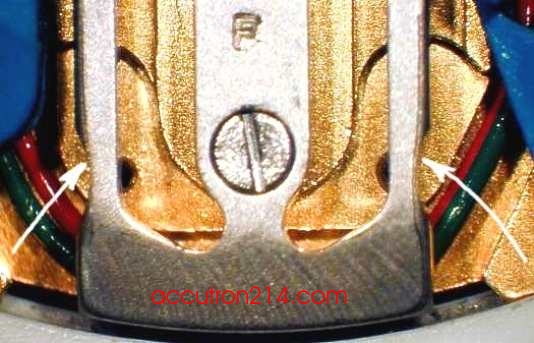 USA. Currently available silver oide batteries produce 1.55 volts. Perfect adjustment of the
index mechanism was not as critical with the lower voltage of mercury batteries
as it is with current batteries. The higher voltage (+0.2V) can cause some
movements to run too fast.
USA. Currently available silver oide batteries produce 1.55 volts. Perfect adjustment of the
index mechanism was not as critical with the lower voltage of mercury batteries
as it is with current batteries. The higher voltage (+0.2V) can cause some
movements to run too fast.
The bottom of each 214 tuning fork tine was notched at the factory to set the frequency. A relative few have tuning forks that were cut to the thinner end of their tolerances. This was OK when the magnets were energized by 1.3 volts but at 1.5 volts those forks are over-active. This causes them to index two teeth instead of one either periodically or with every stroke.
Fortunately there is a way to solve the problem. A 1.5v battery that has been
modified to lower its output to 1.3 volts is available. See
Batteries for Accutrons
#02.
How can I tell the age
of my watch?
A. Bulova marks the date on their watch cases
and movements as follows. On the back cover of the watch, below the serial
number at the bottom there is a tiny
date code which is comprised of a letter followed by a number. On all 214 and 218 calibers, the letter will be either an M or an N. The letter represents the decade in which the watch was made. M=1960s and N=1970s. The number following the letter is the year of manufacture. Examples: M0=1960, N4=1974.
The 1975 Accutron "Anniversary Spaceview" (Bulova
1875/1975) has no date code. Movements
are usually stamped on the back at the 12 o'clock position and Some 1960/61
movements have no date code.
#03. Can I still get a battery for my
Accutron 214 wristwatch?
A.
The Accutron circuit was designed to run
with 1.3 volt mercury batteries which are no longer available in the USA.
Modern 1.5v silver oxide batteries work well for most 214's but a small percentage will run incredibly fast due to the additional 0.2 volts.
Readily available 387S silver oxide batteries are the exact same physical size
as the original 214 batteries and they come with the same plastic insulator that
was standard on the originals, but like all modern batteries they are 1.5 volts.
Even if your 214 runs well with the new batteries, the longevity of your coil could be at risk. There is no longer any doubt that all 214's will benefit from a reduction in voltage back to the original 1.35 volts.
Fortuately there are ways to solve the problem. Accucell-1 batteries have an electrically connected diode which lowers battery voltage in the circuit by 0.2 volts. Alternately, a diode can be added to the electric circuit inside the movement. Either way, the watch will perform as it should, and the life of the coil will be extended.
#04.
How
can I tell
if my watch is a model 214?
.A.
If your watch sets from the rear of the case by lifting and turning the spring
loaded "C" shaped lever, it is a first edition model 214.
#05. Does Bulova still repair the 214 and can
I get parts?
A.
Bulova stopped repairing or making parts for Accutron 214 watches years ago.
Accutron 214 repair parts used today are either obtained from estate sales and
retired watchmakerstaken or from working 214 movements.
#06.
How
do I identify my particular model & what information is coded into the
serial number?
A. 214's were made in the USA
and in Switzerland. Serial numbers that begin with a letter were made in the USA
(ex: A12345). Serial #'s that begin with a number are Swiss made (ex: 1-234567).
The serial number contains no other useful information about the watch. Inside
of the back cover there is a 4 digit case number stamped in ink. That number is
the key to all information about the model. Unfortunately, on many covers the
printed case numbers have been removed during a previous cleaning.
A. Bulova was overly optimistic in 1960 when they first marked the 214 model as "waterproof". Accutron 214's have always been susceptible to water damage. There are 4 places where water can enter.
The crystal
The setting stem (crown)
The battery hatch
The back cover
In my opinion, the seal around
the plastic crystal is the main source of water entry. One solid whack is enough
to crack the crystal and lose the seal. A new crystal can solve this problem but
the setting stem is another matter entirely.
The recessed setting stem on the back cover of a 214 is it's signature feature. The stem assembly has a built-in "O" ring which can't be replaced without risking damage to the stem itself. From 1960 through the late 80's In order to remain "waterproof", Accutrons received a new stem every five years or so. Since new replacement stems are no longer available the stem remains a weak link for water entry.
If you notice moisture in your 214 don't panic. Any watch that has been serviced within the last 3 to 5 years still has an oil film on the steel gear shafts. In any case, do the following as soon as possible:
If outside use a dime to remove the battery cover and place the watch, battery side up in the sun until the moisture has evaporated (caution: do not allow the watch to become overheated). On cloudy or rainy days, depending on the season, go to a heated or air conditioned place, remove the battery cover and leave it off long enough for the moisture to evaporate out of the case. Either way, when you close the hatch the humidity in the case will be at an ambient level. On hot humid days moisture problems are exacerbated by a sweaty wrist so keep the watch in a pocket or briefcase until you are in a comfortable environment.
#08.
Why
does the second hand jump when my watch is shaken
or set and is it ok?
A. It's
perfectly normal. 214's have a lot of backlash in the gears. This is necessary
due to the very light force that the tuning fork is capable of exerting on the
gear train. You will notice that although the second hand sometimes jumps when
you set the time, or bump the watch against something, the hand will wait until
the backlash is used up and then start to turn again without losing a second.
#09. My 214 sometimes makes a sort of buzzing/ringing sound. Is this a problem and if so, what is it?
A. Railroad and Astronaut models are equipped with a part called a "hack spring". The hack spring stops the watch while the time is being set. The sound that you hear is that of the tuning fork tapping against the hack. Normally, when the setting lever is lifted the spring moves to contact the fork, thereby stopping it. When the setting lever is flipped back down flush with the case the hack should be moved away from the fork. Your hack spring is not properly adjusted.
#10.
Which
band or bracelet came on my watch when it
was new?
A. I
wouldn't know exactly which band came on your watch from the factory but I do
know that the Accutron line was sold exclusively by jewelers who would swap the
band on any Accutron for another which was more to the buyers liking at the time
of sale. We do know that precious metal cases came with leather bands because
the contact between a metal bracelet and the soft case eventually causes damage
to the inside of the lugs. Many customers opted for metal bracelets anyway.
Accutrons are authentic when sporting any Accutron band or bracelet that was
available at the time of original sale.
#11. My watch stopped so I installed a new battery but it won't run and it doesn't hum any more. What's wrong?
A. Many 214s will start spontaneously when a new battery is installed but some will not. Over the years the permanent magnets on the tips of your tuning fork may have lost some of their strength. If this is the case you will need to jump-start the movement. A sharp smack with the palm or knuckles of your hand at the 3 or 9 oclock position should cause the tuning fork to start to vibrate. Once started the watch will perform normally until the battery dies. Also see: Intermittent Battery Contact.
If the watch still doesn't run or hum the coil is probably bad. The wire on an Accutron coil is so thin (0.0006" diameter) that it can be easily broken. Coil wire can become brittle while the watch is in storage with no battery installed due to repeated expansion and contraction of the wire over the course of many years. Momentary heat generated by high start-up current is usually the proverbial "straw that brakes the camels back". Occasionally the soldered ends of the wire break at the terminal where the wire goes into the coil. A very few of these coils (perhaps 1 out of 10) can be repaired by applying a conductive compound to the break. Most shorted coils have a break within the windings and can't be repaired.
#12.
Is
it ok to run an Accutron that has been in
storage for a long time?
A.
This is one of the common reasons why coils, index wheels
and tuning forks fail.
Tuning fork driven movements that haven't been cleaned and oiled in the previous 5 years
should be serviced before being put back on your wrist. When a movement has not been
cleaned in many years the old oil dries up
like paint and the gear train becomes hard to turn. In addition one or more
parts of the movement can rust from moisture which will cause a jammed gear train. Either
of these problems can lead to three kinds of damage.
1. The tiny jewel that pushes the index wheel (ratchet) will poke at the wheel which now offers increased resistance to turning causing damage to the tiny teeth.
2. The index jewel is cemented to a metal finger which pushes against the teeth on the index wheel. If the index wheel doesn't turn freely, the cement bond can break causing the jewel to fall off.
3. Accutron coil wire is so thin (0.0006" diameter) that it doesn't take much to cause it to break or for the insulation to fail. When an Accutron is started up in a cleaned and lubricated 214 movement there is a very slight momentary spike in the micro amps through the coil. The starting amps in a gummed up coil are much higher making it possible for a borderline coil to die at the moment electricity is applied. Think of it as an electric motor. Motors have a built-in fan to keep them cool. When an electric motor is prevented from turning while power is being applied the coil wire temperature will rise to the point where the coil burns up. The Accutron coil will not burn but repeated thermal expansion and contraction however slight eventually will cause metal fatigue and it seems obvious to me that even a small amount of sudden thermal expansion of the delicate wire won't do the coil any good. Anyone who has had a light bulb burn out instantly when the light is switched on, has witnessed the damage that starting current can do to a filament that is already weakened from metal fatigue.
A clean, well lubricated Accutron will run cool and happy for a long time. I recommend a service interval of 3 to 5 years.
#13.
What is the value
of my watch?
A. This
is an impossible one to answer without inspecting the movement as well as the
condition of all of the external parts.
The value of any watch depends on many factors. The first and most important factor is supply and demand.
There are some 214 models that came out in the 70's that are fairly rare but because they are not particularly attractive, they are not in demand.
Then there are some models
that are very popular, but because they are plentiful, they are not particularly
expensive.
If a lot of people want a particular watch and there aren't many of
them available, the value of that watch will be higher.
How high will be
determined by the following factors in order of importance:
CONDITION:
Does the watch run and keep accurate time?
Is the
case clean?
Is it scratched and/or dinged?
Are the lugs bent?
Is the
dial spotted, stained, crazed, corroded or flaking?
Is the luminous clean and
does it still glow?
Is the crystal scratched or cracked?
Is there a band?
Is the band new and if not, is it vintage Accutron?
Has the movement been
serviced in the last 3 years?
Is the watch new-
old-stock
(like
new, never worn).
ADDITIONAL FACTORS:
Personalization: Unless the watch was owned by someone of importance, personal engraving will decrease the value of any watch considerably.
If such a connection can be authenticated by photographic, or documentary evidence to establish provenance, memorabilia collectors could drive the price up dramatically.Recently Serviced: Any vintage watch that has been recently serviced is worth more at time of sale due to the expectation of fewer problems and greater dependability.
Warranty: A one year warranty is worth about 50% of the basic service charge.
Original Boxes: No small detail. If you have the original case and outer cardboard box along with the Accutron coin and papers the value increases considerably.
Original Band: Vintage Accutron bands in good condition are very much in demand these days.
First Year: The first year of a particular model. Depending on the model, values will be slightly higher than those that came after it.
#14. How do I know if my Spaceview is a conversion?
A. First we need to establish what the various terms really mean.
"Spaceview" is the suffix that Bulova added to the model name or number for the very few Accutron models which were produced without dials. It simply means that the movement can be seen.
"Factory Spaceview" is not an official name, it is a descriptive term meaning that the watch left the factory as a Spaceview model.
"Genuine Spaceview" means that the watch is "as factory" and as such you could never be certain if it is a factory Spaceview or a correctly done, "as factory" conversion.
"Converted Spaceview" means that the dial has been removed. Most conversions can be spotted because of errors or inconsistencies in the conversion process.
Most of the 214 Spaceview watches found today are conversions. Because of the popularity and added value of Spaceview models, brand new crystals that fit non-Spaceview models are being printed with Accutron markings today. These Spaceview crystal sizes were not made by Bulova and therefore were not available in the sixties and seventies so they couldn't have been converted at the time of sale. Those watches were originally manufactured with dials. At some point the dials were removed and a non-original Spaceview crystal was installed to simulate a genuine Spaceview model. The results vary wildly. Most of the 214 case styles made by Bulova were never sold as Spaceview models and the conversions are easily detected. Others are very difficult to spot. A properly done conversion is indistinguishable from the factory model and a few of the converted models are so attractive that they are highly sought after. Here are some things you can look for to spot an imperfect conversion.
Hands: The hands are the best tip-off. With the exception of Swiss Spaceviews which have gold or nickel plated hands, 1960's Spaceview hands were painted flat white. The original white paint should appear pebbly under magnification. The hour and minute hands always had luminous centers which makes it difficult to paint a gold or silver hand white without getting some paint on the luminous. That doesn't stop some dealers from simply painting over the entire hand, luminous and all.
From 1960, the year of introduction, through 1969, Spaceview second hands were always white. In 1969 a Spaceview model (the "Cushion Case") with an orange second hand was introduced. Other models followed that had orange or red second hands. Over the years many of the orange hands have faded to yellow.
Some case styles were always made with specific hand styles and these combinations changed with time, therefore, visual familiarity is required to spot a wrong combination.
Chapter Ring: A chapter ring is a metal ring with minute and hour markings that fits under the crystal just above where the dial normally would be.
The chapter ring case is specially machined to accept the reflector
leaving room for the crystal to be pressed in on top of it. Minute markers are
painted around the ring with a
luminous dot or dash at 12:00 Oclock and luminous
dashes at hours 1:00 through 11:00 Oclock or at 3:00, 6:00, and 9:00 O'clock.
Some conversions are fitted with a dial that has had its middle cut out to leave just the hour/minute markers. This simulated chapter ring method has tricked many novices into paying too much for watches that are easily seen as phonies by an experienced buyer. Take note as to whether the ring is concave (dished) or convex (spherical). Genuine rings are concave and cutout dials are always convex.
Cases: When a wrong case style is converted to a Spaceview
the result looks odd to a collector. Again, visual familiarity is necessary to
spot the fake.
#15. What is the difference between a deceptive conversion and an honest one?
A. There is nothing wrong with a converted Spaceview, but they should never be advertised as a factory original.
#16. Is the red second hand on my Spaceview correct?
A. These days, most of the people who convert 214's to "Spaceview" models, and re-sell them, are painting the second hands red. A red second hand on any Spaceview should be viewed with suspicion and particularly if the date code is M9 (1969) or earlier. The only 214's that came from the factory with a red second hand prior to 1969 was the Railroad Approved model. During the early years all U.S. Spaceview models had white second hands and all Swiss Spaceview hands were gold or nickelll plated. During the 70's when the 218 was king and 214 sales were lagging, Bulova introduced a few new Spaceview models which had red second hands but they did not sell very well and so we don't see very many of them..
#17. Why does my Accutron seem to run slower when I don't wear it?
A. Try this yourself. Take the battery out of the watch and hold it in either hand. With the other hand smack the watch case on the side (at 3 or 9 o'clock) so as to cause the tuning fork to vibrate. Immediately observe the second hand. You will notice that the movement will run for a few seconds without a battery. Now replace the battery and imagine what happens when the movement is shocked while it is running. The answer is that the movement will gain a fraction of a second each time the tuning fork is given some extra energy due to shock or vibration. This tendency of the watch to run faster when in motion has to be compensated for by adjusting the movement to lose two seconds a day when at rest...
Putting these two influences together causes them to pretty much cancel each other out when the watch is worn..
#18. What is a hack, and what does it do?
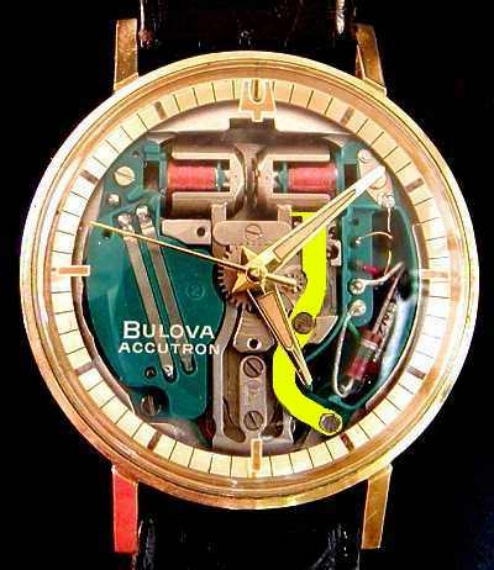
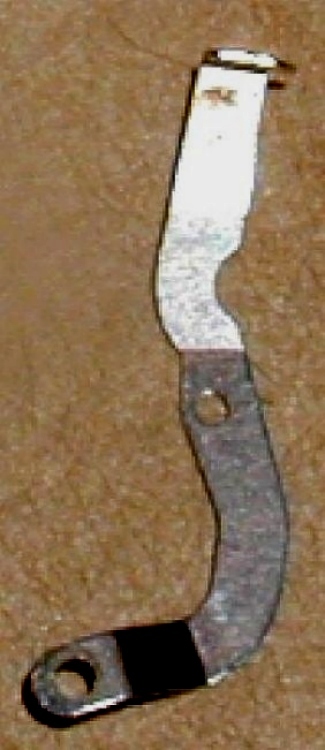
A. The Hack Spring pictured below is mounted on the front of the movement. It stops the tuning fork when the setting stem is lifted. Astronauts, Railroad Approved, and many Swiss models came from the factory with the spring installed.. The "hackk" is highlighted in the photo belo.. Correct adjustment of this feature is critical.
#19. Should I
stop my Accutronn when I'm not wearing it?
A.
Opinions vary on this
one..
NOT TO RUN: Although it takes many years to accumulate any appreciable wear on a 214 mechanism, many collectors feel that there is no point in adding unnecessary wear to a movement or coil that may already be borderline.
TO RUN CONTINUOUSLY: When an Accutron is started up there is a momentary spike in the amps through the coil. It is possible for a weak or failing coil to die at the moment electricity is applied. Think of a light bulb that blows at the moment you flip the switch. Once an Accutron is running the amps through the coil settle down to a comfortable level and even a weak coil will run indefinitely in this state. Another benefit of allowing the movement to run is that the oil on the bearings will maintain an even coating of protective lubrication on the steel gear shafts.
In my opinion, if you're not going to wear your 214 for a period of several months or more, I would back out the battery hatch a few turns until the watch stops. Otherwise let it run. Never leave a dead battery in the watch.
IMPORTANT: Keep in mind that a 214 is only vulnerable to the entry of dirt and fiber particles when the battery hatch is open. Anyone who has ever looked at his own fingers under a high power microscope will tell you that it's wise to treat the process as if it were open heart surgery. Open the patient as few times as possible but when it becomes necessary, make sure that hands, battery and tool are scrupulously clean.
#20. What should I do if my 214 won't start with a new battery?
A. Most 214s will start spontaneously when a new battery is installed but some will not. Over the years the permanent magnets on the tips of your tuning fork may have lost some of their strength. If this is the case you will need to jump-start the movement. A sharp smack with the palm or knuckles of your hand at the 3 or 9 oclock position should cause the tuning fork to start to vibrate. Once started the watch will perform normally until the battery dies..
#21. Is it true that the 360 cycle/second hum of an
Accutron has a calming effectt on
the wearer?
A. I have heard this theory proposed by folks who also believe in the healing power of magnets, crystals, and/or pyramids. They believe that there is something about the frequency of the softly humming tuning fork and the small but powerful magnets in close proximity to the arteries in the wrist that has aabeneficial effect on the wearer..
I won't even try to answer this one, but personally, I always feel better when I'm wearing one of my Accutrons.
#22. What musical noteeis the
Accutron hum closest to?
A.
A
properly set up
Accutron 214 or 218 vibrates at a frequency of 360Hz (a slightly flat F# on the
piano).
Accutron214.com on Facebookk
| Home
© 2002 by Martin
Marcus. All rights reserved. These pages may not be copied without written
consent..